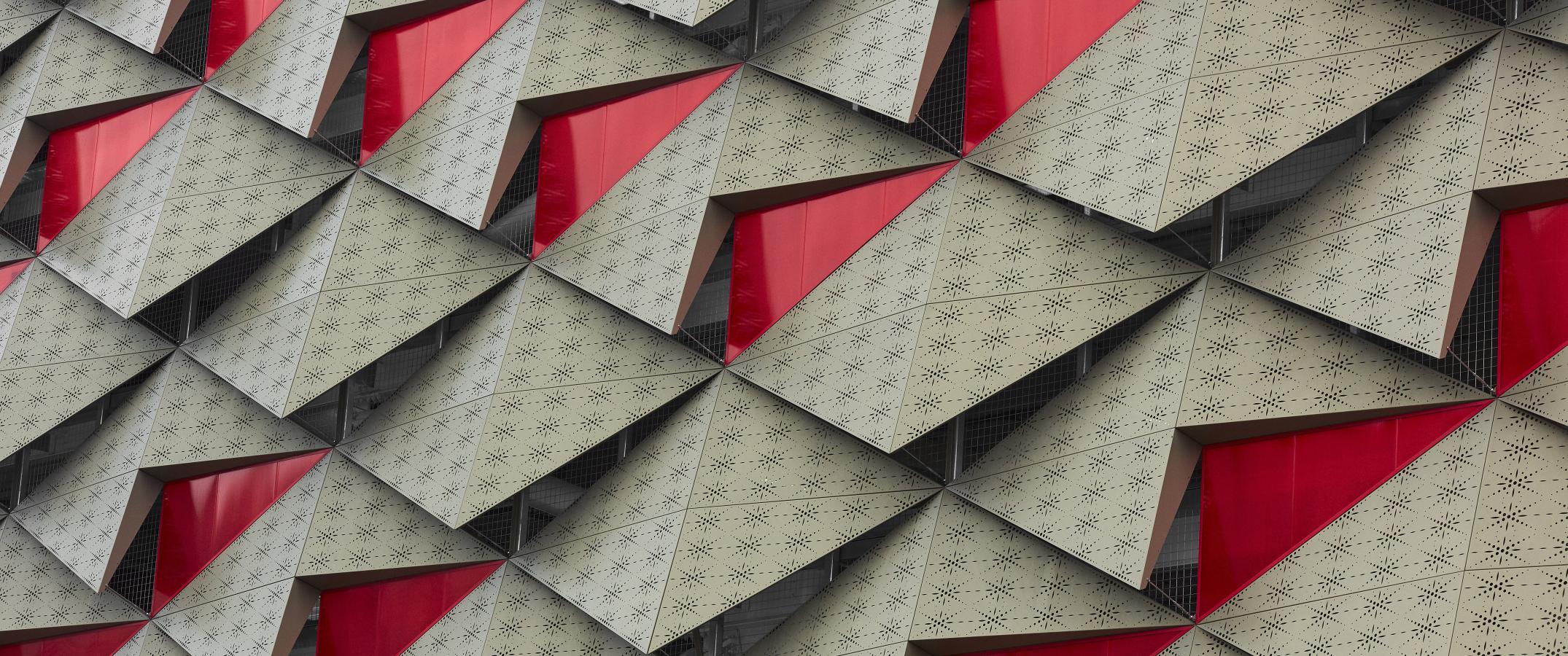
Type of Patterns
Trying to describe all of the possible patterns you could put on a facade is way beyond the scope of this humble blog. For example, there are a countless number of patterns in maths. Well, there’s actually 3 main ones at last count. Either way, we’re not talking paint-by-numbers here so they’re a little (but not completely) irrelevant.
Nature has 9 main patterns; symmetries, trees, spirals, meanders, waves, foams, tessellation, cracks and stripes. Of these, trees might be the most interesting as an example of a fractal pattern.
The term ‘fractal’ was introduced by Benoit Mandelbrot in 1975 after he discovered that mathematical rules apply to a vast number of patterns that are unusually complex. Maths really does count in all parts of life then. That’s not what’s interesting here though (at least we don’t think so). What’s really interesting is the effect fractal patterns have on us humans.
According to Psychology Today, fractal patterns can reduce stress by up to 60%. No doubt, a good portion of the stress-busting ability of fractal patterns, which is usually found in nature, comes from the context of their setting. Yet research indicates artwork with fractal patterns can promote relaxation too.
Whilst not exactly a fractal pattern, it would be easy to assume the custom dapple design at Windy Ridge School will have a relaxing effect on the students. Obviously not enough to make them drowsy in class but just enough to turn the teen angst down a little.
Whatever the pattern developed, a few natural assumptions seem to hold water. For example, if a pattern has soft angles and gentle curves, it’s generally considered to be welcoming and friendly. Indeed, just look at the language we use to describe the pattern; soft angles and gentle curves. We know the reader will instinctively know what this means. Whereas if we say harsh angles, it conjures images of sharp turns and lines that are bold and almost angry.
So if patterns can be used for good - just how do we do it? Unsurprisingly, we have a few ideas here…